Variation marker · Pas de quatre · Moonlight
Moon / Diana Variation
Diana's moonlit solo brings a calm, sculptural quality to the sequence before dawn arrives. Times are specific to the supplied production.
- Start
- 6:27
- End
- 7:45
- Duration
- 1:18
Ballet guide 09 · One-act ballet anacréontique
Moonlight, dawn, sunlight, and the winds awaken a sleeping garden as the nymph Chloris becomes Flora—the immortal goddess of flowers.
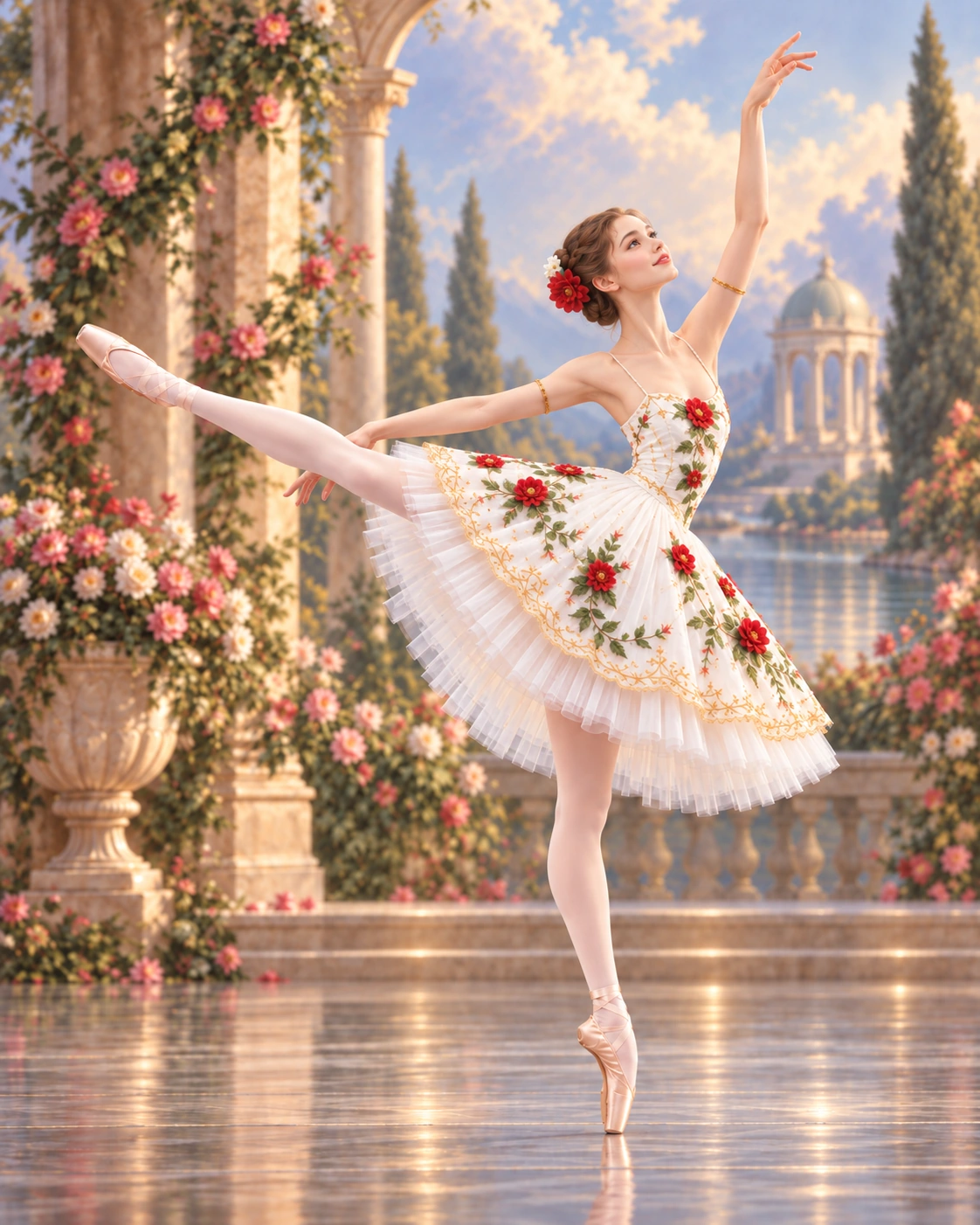
Flora · Goddess of flowers and spring
Featured study excerpt · begins at 00:00
The supplied 2018 Vaganova Ballet Academy gala opens with a pas de quatre from Le Réveil de Flore. It is an excerpt rather than the complete one-act ballet, bringing together Flora, Aurora, Diana, and Hebe in a compact showcase of four distinct classical qualities.
Vaganova Ballet Academy Jubilee Gala · Bolshoi Theatre · 2018Pas de quatre at 00:00 · music by Riccardo Drigo · playback is hosted by YouTube.
Open supplied reference ↗Variation marker · Pas de quatre · Moonlight
Diana's moonlit solo brings a calm, sculptural quality to the sequence before dawn arrives. Times are specific to the supplied production.
Variation marker · Pas de quatre · Dawn
Aurora brightens the stage with buoyant phrasing and crisp, sparkling footwork as the garden wakes. Times are specific to the supplied production.
Variation marker · Pas de quatre · Youth
Hebe’s Youth variation brings bright pizzicato energy, quick articulated footwork, and a sparkling youthful quality to the pas de quatre. Times are specific to the supplied production.
Variation marker · Pas de quatre · Full bloom
Flora closes the featured sequence with lyrical amplitude, sustained line, and the fullest bloom of the garden imagery. Times are specific to the supplied production.
Full ballet reference · begins at 57:32
This additional supplied reference opens directly at 57:32, where The Awakening of Flora begins within the longer video. Use it alongside the first pas de quatre reference to compare staging, phrasing, and production choices.
Second supplied full-ballet referencePlayback begins at 57:32 · hosted by YouTube.
Open supplied reference ↗Variation reference · West wind · Zephyr
Zephyr's variation runs from 20:02 to 20:47 in this second reference.
Variation reference · Flora · Harp
Flora's variation runs from 30:33 to 33:00 in this second reference.
The complete story
The ballet unfolds in six tableaux and an apotheosis. Greek and Roman names are both associated with the roles; this guide uses the familiar stage names first and gives important alternatives in the character notes.
Tableau
Night rests over a quiet grotto where the nymph Chloris—newly married to Zephyr and already called Flora—sleeps among her companions. Diana, goddess of the moon, watches over them until the first chill of dawn gathers in the air.
The ballet begins in stillness. Its opening world is cool, protected, and suspended between night and morning, so every later arrival can transform the stage through a new quality of light and movement.
Tableau
Aquilon, god of the north wind, sweeps violently through the garden. His cold breath wakes Flora and drives the nymphs toward the shelter of the foliage. Chilling dew leaves Flora distressed and searching for help.
Flora appeals to Aurora, goddess of the dawn. The garden's awakening is therefore not instantaneous: it begins as a struggle between the last cold of night and the promise of warmth.
Tableau
Aurora consoles Flora and promises that Apollo, god of the sun, is close behind her. Flora, Aurora, and the nymphs dance together as the sky brightens and the garden begins to recover its color.
This tableau turns dawn into choreography. Aurora does not finish the transformation herself; she prepares the world for the radiance and abundance that Apollo will bring.
Tableau
Apollo appears and everything comes alive. Enchanted by Flora's beauty, he summons her husband Zephyr, god of the west wind. Cupid and the little amours follow, celebrating the lovers in a classical pas d'action.
The central pas d'action gives the ballet its emotional center: spring is not only sunlight or flowers, but the harmony of Flora and the gentle west wind.
Tableau
Mercury announces Hebe, goddess of youth, and Ganymede, cupbearer of the gods. They offer Flora and Zephyr divine nectar and proclaim Jupiter's gift of eternal youth.
Chloris is fully transformed. No longer only a mortal nymph, she becomes Flora, goddess and sovereign of flowers, gardens, orchards, and the renewal of spring.
Tableau
A procession arrives with Bacchus and Ariadne, followed by bacchantes, satyrs, fauns, and woodland spirits. A grand pas and rushing finale expand the lovers' joy into a public festival.
In the apotheosis, Olympus is revealed and the assembled gods complete the ballet's journey from a dark sleeping grotto to a radiant divine world.
Meet the characters
The ballet's roles are personified forces: moon, wind, dawn, sun, love, and youth. Their contrasting movement qualities make the simple myth feel like a complete transformation of the natural world.
Nymph transformed into the goddess of flowers
The ballet follows her awakening from cold and uncertainty into warmth, love, immortality, and command of the blooming natural world.
God of the west wind
Flora's husband and the gentle wind of spring. His reunion with Flora forms the heart of the pas d'action.
Goddess of the moon
Also named Selene in Greek usage. She guards the sleeping nymphs and establishes the ballet's quiet nocturnal opening.
God of the north wind
Also named Boreas. His forceful arrival awakens Flora with cold and creates the conflict that dawn and sunlight must resolve.
Goddess of the dawn
Also named Eos. She comforts Flora, heralds the sun, and brings the first warmth and color to the garden.
God of the sun
Also named Helios in the reconstructed Greek nomenclature. His radiance revives the garden and calls Zephyr to Flora.
God of love
Also named Eros. He arrives with the amours and turns Flora and Zephyr's reunion into a celebration of love.
Goddess of youth
She brings divine nectar with Ganymede. Her bright pizzicato variation was added to Drigo's score after the 1894 premiere.
For variation students
The gala excerpt features Alexandra Khiteyeva as Flora, Yulia Spiridonova as Aurora, Svetlana Savelieva as Diana, and Maria Bulanova as Hebe. Watch how each dancer creates a separate atmosphere while preserving the shared elegance and musical detail of the ensemble.
Return to the referenceBegin with composure and sculptural clarity. Let the port de bras feel watchful and unhurried, as though the garden is still asleep.
Bring warmth and lift without rushing. The dancing should brighten the stage gradually, carrying the promise of the sun.
Keep the buoyant pizzicato crisp, playful, and polished. Quick footwork needs a light upper body and precise musical sparkle.
Combine lyrical amplitude with classical authority. The softness belongs to a goddess whose garden has come fully alive, not to a fragile flower.
Behind the ballet
Petipa created Le Réveil de Flore for the 1894 wedding celebrations of Grand Duchess Xenia Alexandrovna and Grand Duke Alexander Mikhailovich at Peterhof Palace. Matilda Kschessinskaya created the title role. The ballet moved to the Imperial Mariinsky Theatre in January 1895.
Its choreography was recorded soon after the premiere in Stepanov notation and survives in the Sergeyev Collection. Sergei Vikharev used that record for his acclaimed 2007 Mariinsky reconstruction, which received the Golden Mask. Yuri Burlaka's Rose Pas de Quatre later helped the solos for Flora, Aurora, Diana, and Hebe reach students and competition stages far beyond the full ballet.