BBallet Variation Studio
← Full ballet library

Ballet guide 10 · Revolutionary ballet in two acts

The Flames of Paris

A village injustice becomes a march on Paris as classical bravura, character dance, and the force of the crowd carry Jeanne and Philippe into the French Revolution.

Music
Boris Asafyev
Choreography
Vasily Vainonen / Alexei Ratmansky
Libretto
Nikolai Volkov / Vladimir Dmitriev
World premiere
Kirov Theatre · 1932
Watch the full ballet
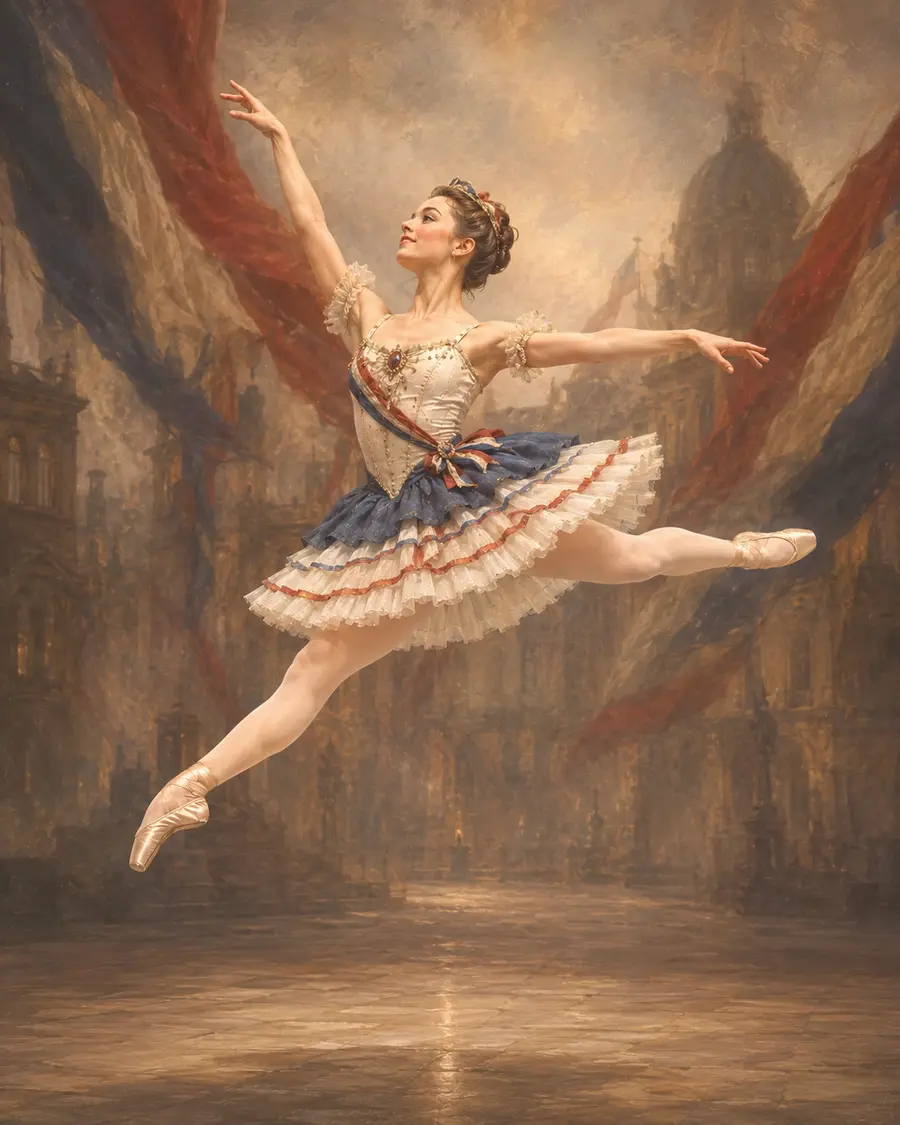
Illustration of Jeanne leaping in a red, white, and blue costume against a revolutionary Paris backdrop

Jeanne · Revolutionary heroine

Full ballet reference · begins at 00:00

Watch the Bolshoi production from the beginning.

The supplied full-performance reference presents Alexei Ratmansky's two-act Bolshoi staging, built from surviving choreography by Vasily Vainonen and newly choreographed dramatic material.

The Bolshoi Ballet · Full performanceRunning time 1:42:57 · playback is hosted by YouTube.

Open supplied reference ↗

Variation in the Finder · Amour · Female role

Amour Variation

Study Amour's buoyant court-ballet solo with the approved white-tunic artwork, both supplied music versions, coaching notes, and the exact YouTube reference. These times are specific to the supplied production.

Start
30:11
End
31:48
Duration
1:37

Variation in the Finder · Mireille de Poitiers · Female role

Mireille de Poitiers · Gavotte Variation

Study the rare courtly solo—also known as Lully's Gavotte—with all three supplied music versions, coaching notes, and Eva Shinn's YAGP reference. These times are specific to the supplied production.

Start
38:43
End
40:06
Duration
1:23

Variation in the Finder · Philippe · Male role

Philippe · Male Variation

Study Philippe's heroic male variation with all seven supplied music versions, training notes, competition guidance, and the supplied YouTube reference. These times are specific to the supplied production.

Start
1:25:33
End
1:26:31
Duration
0:58

Variation in the Finder · Jeanne · Female role

Jeanne · Female Variation

Study the exuberant female solo with coaching notes, technical elements, eligibility guidance, music, and the supplied competition reference. These times are specific to the supplied production.

Start
1:27:23
End
1:28:32
Duration
1:09

The complete story

Private courage gathers into public revolution.

Ratmansky's Bolshoi version compresses the original four-act scenario into two acts. The countryside, Versailles, and revolutionary Paris move past quickly, while Jeanne, Philippe, Jérôme, and Adeline keep the human stakes visible inside the spectacle.

01

Chapter

A village on the edge of revolt

In the countryside near Marseille, Jeanne and her brother Jérôme live among peasants already restless under aristocratic rule. A passing hunting party brings the Marquis de Beauregard into their world, and his abuse of power turns private anger into open resistance.

The ballet begins by making the conflict physical: courtly privilege and the energy of the people occupy the same stage, but they move with completely different weight, rhythm, and purpose.

02

Chapter

The Marseillais march toward Paris

Philippe arrives with the volunteer battalion from Marseille. Jeanne is drawn to his courage and to the revolutionary cause. Jérôme is arrested after defending his family, while Adeline, the Marquis's daughter, risks her own safety to help him escape.

Two young couples cross the class divide in opposite directions: Jeanne chooses the revolution beside Philippe, while Adeline abandons the protection of her rank for Jérôme.

03

Chapter

Versailles performs while France changes

At the royal court, dancers and actors entertain Louis XVI, Marie Antoinette, and the aristocracy with a polished theatrical divertissement. Beyond the palace, the revolutionary march grows louder and the court's elegant rituals begin to feel dangerously detached from the country outside.

The court ballet is deliberately brilliant. Its refined classical display does not pause the drama; it shows a world so absorbed in spectacle that it cannot recognize how quickly power is shifting.

04

Chapter

Paris becomes the stage

The Marseillais reach Paris and join the uprising. Crowd scenes, character dances, military formations, and revolutionary songs gather momentum until the people storm the Tuileries and the old order collapses.

Here the corps de ballet becomes a principal character. Individual stories remain visible, but the production's defining image is collective motion sweeping across the stage.

05

Chapter

Jeanne and Philippe celebrate a new world

After the victory, Jeanne and Philippe dance the famous pas de deux associated with the ballet. Their variations and coda turn revolutionary triumph into classical bravura before the full company joins the final celebration.

The gala showpiece belongs to the story because its virtuosity is public rather than private: soaring jumps, fast turns, and fearless musical attack embody the crowd's exhilaration.
Meet the characters

A revolution told through people and crowds.

The ballet moves between intimate family choices, young love, royal ceremony, and enormous public scenes. Its many dance styles help each social world feel immediately different.

01

Young woman who joins the revolution

Jeanne

Direct, daring, and fiercely musical, Jeanne grows from a village daughter into one of the ballet's most visible revolutionary figures. Her variation is the work's familiar female competition solo.

02

Leader among the Marseillais

Philippe

Philippe brings the revolutionary volunteers toward Paris and becomes Jeanne's partner. His dancing is built around heroic elevation, speed, and expansive bravura.

03

Jeanne's brother

Jérôme

Jérôme resists the Marquis, is arrested, and escapes with Adeline's help. His story keeps the personal cost of the uprising close to the center of the action.

04

Daughter of the Marquis de Beauregard

Adeline

Adeline crosses the boundary of class and loyalty when she helps Jérôme. In Ratmansky's production, their relationship gives the political conflict a second, more fragile love story.

05

Aristocrat and agent of the old order

Marquis de Beauregard

His violence in the opening countryside scene makes the injustice of the ancien régime immediate and sets Jeanne and Jérôme on their revolutionary path.

06

Artists of the royal court

Mireille de Poitiers and Antoine Mistral

Their theatrical world introduces a contrasting register of powdered elegance and academic classicism inside the increasingly unstable palace.

07

Cupid in the court ballet Rinaldo and Armida

Amour

Amour appears inside the Versailles entertainment and wounds the hearts of Rinaldo and Armida with love's arrow. The brief allegorical role contrasts airy, playful dancing with the court's formal splendor.

08

The royal couple

Louis XVI and Marie Antoinette

They preside over Versailles while the Marseillaise approaches, embodying a court that remains ceremonious even as its authority disappears.

09

The ballet's collective hero

The people of Paris

Peasants, volunteers, market women, and citizens fill the stage with folk dance, character dance, marches, and massed movement. The ensemble drives the historical action.

For variation students

Virtuosity must feel like conviction.

The Flames of Paris is famous for technical fireworks, but the steps gain their force from context. Jeanne and Philippe are not displaying brilliance at court; they are dancing in front of a community at the height of collective celebration.

Study Jeanne's variation
  1. 01

    Jeanne · Fearless allegro

    Keep the footwork clear and the landings buoyant while projecting beyond the technique. The solo needs attack, stamina, and direct communication with the audience.

  2. 02

    Philippe · Heroic elevation

    The male variation turns height and rotation into character. Preparation must stay economical so the jumps read as spontaneous confidence rather than effort.

  3. 03

    Character dance · Grounded rhythm

    The Basque and revolutionary dances use a heavier relationship to the floor than the classical passages. Preserve turnout and placement without polishing away their force.

  4. 04

    Mireille · Courtly Gavotte

    Let the gavotte rhythm organize the steps, coordinate the head and arms with quiet precision, and make the Versailles style gracious rather than stiff. Mireille's polish should contrast clearly with the revolutionary dances.

  5. 05

    Amour · Airborne mischief

    Keep the traveling jumps buoyant and the white-tunic silhouette clean. The bow-and-arrow mime should read instantly without interrupting the long arm lines or quick musical phrasing.

  6. 06

    Pas de deux · A public celebration

    Jeanne and Philippe dance as part of a community. Even the most difficult partnering and coda passages should feel generous, outward-facing, and carried by the crowd.

Behind the ballet

A Soviet revolutionary epic rebuilt for the modern stage.

Vainonen's original Flames of Parispremiered at Leningrad's Kirov Theatre on 7 November 1932. Asafyev shaped the score from melodies associated with the French Revolution, and the production combined classical technique, folk and character dance, pantomime, court spectacle, and mass ensemble scenes.

Alexei Ratmansky created a new Bolshoi production in 2008. He retained important surviving Vainonen passages—including the celebrated Jeanne and Philippe pas de deux—while tightening the scenario into two acts and giving the individuals inside the uprising greater dramatic complexity.

Supplied Bolshoi reference ↗Bolshoi recording and cast ↗Mikhailovsky Theatre history ↗Ratmansky production review ↗
Feedback / Report a bug