BBallet Variation Studio
← Full ballet library

Full ballet 06 · Romantic ballet in two acts

Giselle

A village love story crosses into a moonlit spirit world, where betrayal cannot erase compassion and forgiveness becomes Giselle’s greatest strength.

Music
Adolphe Adam
Choreographic lineage
Coralli · Perrot · Petipa
Premiere
Paris · 1841
Libretto
Gautier · Saint-Georges
Watch the full ballet
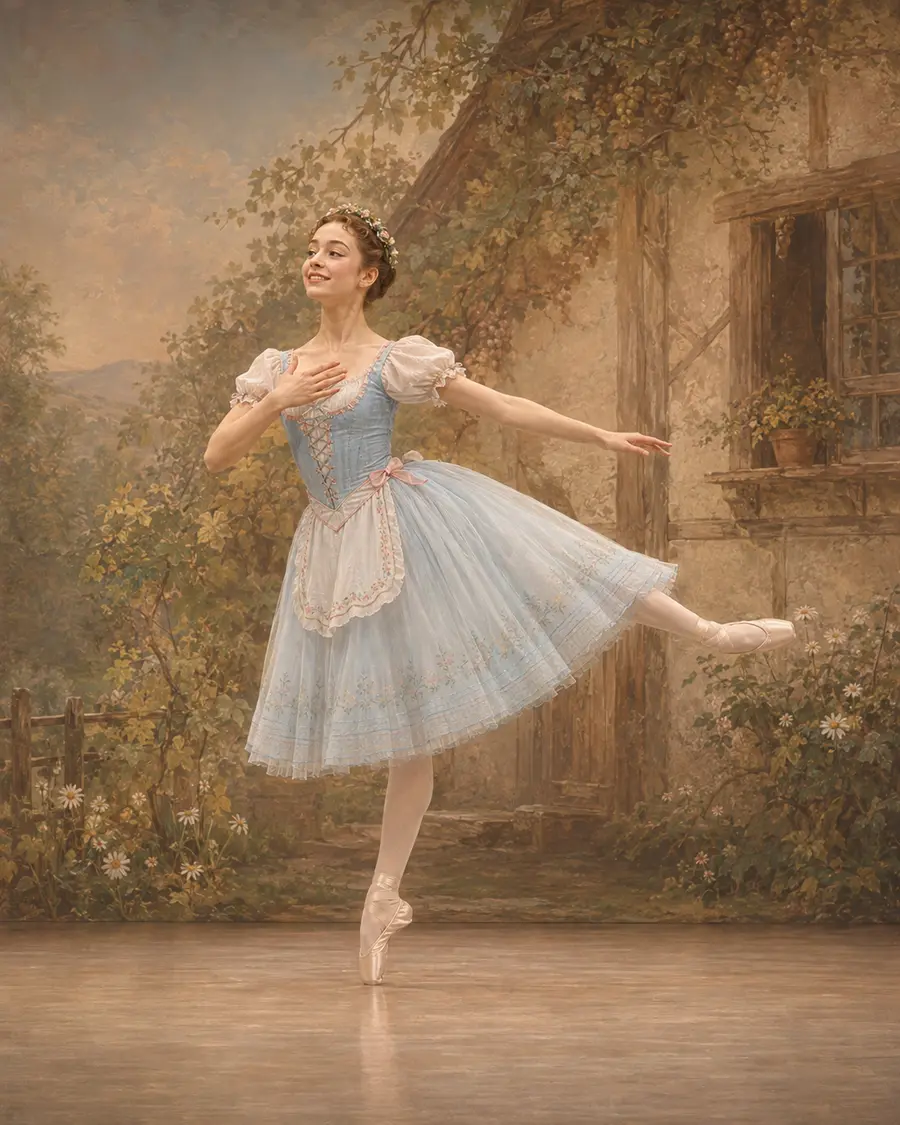
Illustration of Giselle dancing in the Rhineland village during Act I

Giselle · Act I

Watch from curtain to curtain

See sunlight transform into moonlight.

Follow the supplied International Festival Ballet production once for the story, then return to compare Act I’s human warmth with the stillness, lines, and otherworldly musical atmosphere of Act II.

International Festival Ballet · supplied productionFull two-act performance · playback is hosted by YouTube.

Open on YouTube ↗

Variation marker · Act I

Giselle · Act I

Giselle’s Act I solo in the supplied International Festival Ballet production. The marker runs from the opening of the solo through its final phrase. These times are specific to the supplied production.

Start
29:48
End
31:50
Duration
2:02
Watch from 29:48

Variation marker · Act I · Peasant Pas

Peasant Pas · Variation 3

Peasant Pas Variation 3 in the supplied International Festival Ballet production. The marker runs from the opening of the solo through its final phrase. These times are specific to the supplied production.

Start
36:36
End
37:44
Duration
1:08
Watch from 36:36

Variation marker · Act II

Albrecht · Act II Variation

Albrecht’s Act II solo in the supplied International Festival Ballet production. The marker runs from the opening of the variation through its final phrase. These times are specific to the supplied production.

Start
1:34:36
End
1:35:32
Duration
0:56
Watch from 1:34:36

The complete story

Two acts reflected across a grave.

Act I is alive with harvest color, social detail, and human choices. Act II strips the world down to moonlight and ritual, asking whether love can outlast betrayal, anger, and death.

01

Act I

A village celebration becomes a tragedy

During the grape harvest in a Rhineland village, Giselle falls in love with Loys, a young man she believes to be a fellow villager. He is really Duke Albrecht of Silesia, disguised in rustic clothes and already promised to the noblewoman Bathilde. Hilarion, the village gamekeeper, loves Giselle too and distrusts his mysterious rival.

The harvest celebration brings dancing, the Peasant Pas, and a visit from Bathilde and her father. Hilarion discovers Albrecht’s sword and exposes his true identity. When Bathilde reveals their engagement, Giselle’s joyful world collapses. In the famous mad scene she relives the day in fragments, loses her hold on reality, and dies.

02

Act II

Love survives in the forest at midnight

At Giselle’s grave, Myrtha, Queen of the Wilis, summons the spirits of young women who died before their wedding days. The Wilis compel any man they encounter to dance until he dies. Hilarion enters the forest, is surrounded, and becomes their victim. Albrecht then arrives to mourn and ask forgiveness at Giselle’s grave.

Giselle is ordered to dance with Albrecht, but she protects him with a love stronger than Myrtha’s command. She draws him toward the shelter of the cross and sustains him through the night. Dawn breaks before the Wilis can destroy him. Their power fades, Giselle returns to her grave, and Albrecht is left alive—changed by grief, forgiveness, and her final act of devotion.
Meet the characters

Every entrance changes what Giselle believes.

The tragedy depends on relationships, not pantomime alone. Knowing what each character wants gives the dancing its urgency and makes the shift into Act II emotionally clear.

01

The village girl

Giselle

Warm, musical, and deeply trusting. Her Act I innocence and Act II spiritual strength are two expressions of the same capacity for love.

02

The disguised duke

Albrecht · Loys

A nobleman who courts Giselle under a false identity despite his engagement to Bathilde. His deception causes the tragedy he must face in Act II.

03

The gamekeeper

Hilarion

Devoted to Giselle and jealous of Loys. He uncovers Albrecht’s identity, but his truth-telling cannot prevent disaster and leads him into the Wilis’ forest.

04

Queen of the Wilis

Myrtha

Commanding and implacable. She rules the moonlit second act with breadth, stillness, and a supernatural authority untouched by human pleading.

05

Albrecht’s betrothed

Bathilde

A noblewoman who treats Giselle kindly before either woman understands their connection. Her engagement ring makes Albrecht’s betrayal undeniable.

06

Giselle’s mother

Berthe

Protective and perceptive. She worries about Giselle’s fragile heart and warns that girls who dance themselves to death may become Wilis.

For variation students

Know whether you are dancing in sunlight or moonlight.

The Act I Giselle and Peasant Pas solos grow from the harvest celebration; Albrecht's Act II variation belongs to the moonlit world after the tragedy. Both need Romantic softness, but their dramatic weight is completely different.

Find the Giselle variations
  1. 01

    Giselle · Act I

    Place the pointe hops, turns, and quick footwork inside a spontaneous village celebration. The technique is advanced, but Giselle must still appear guileless and newly in love.

  2. 02

    Giselle Pas de Deux Variation · Act I

    Let the petit battement, balances, and delicate pointe articulation unfold as complete musical thoughts. The exposed classical detail still belongs to Giselle's youthful, sincere world rather than a formal technical display.

  3. 03

    Peasant Pas · Variation 1

    This bright female solo belongs to the harvest festivities before the tragedy. Buoyant allegro, neat fifth positions, and open Romantic épaulement should feel generous rather than competitive.

  4. 04

    Peasant Pas · Variation 2

    Give the floating attitudes and traveling lines enough time to breathe before the buoyant jumps and turning finish. The broader phrasing should still feel spontaneous, warm, and rooted in the harvest celebration.

  5. 05

    Peasant Pas · Variation 3

    Keep the fast pointework, traveling steps, and light jumps crisp without hardening the shoulders. Its village warmth matters as much as the clarity of the feet.

  6. 06

    Peasant Pas · First Male Variation

    Batterie and elevation grow out of a public celebration. Clean beats, soft landings, and an easy upper body create the gallant, joyful quality of the Peasant Pas.

  7. 07

    Peasant Pas · Second Male Variation

    Let the traveling allegro and larger jumps feel buoyant rather than heavy. Readable beats, connected plié, and an open gallant presence keep the virtuosity inside the harvest celebration.

  8. 08

    Albrecht · Act II Variation

    Place the batterie, cabrioles, turns, and suspended jumps inside Albrecht's remorse at Giselle's grave. The technique is brilliant, but its scale must read as grief and pleading rather than triumph.

Behind the ballet

The Romantic ballet that never left the stage.

Giselle premiered at the Paris Opéra on 28 June 1841, with Carlotta Grisi in the title role. Adolphe Adam composed the score; Théophile Gautier and Jules-Henri Vernoy de Saint-Georges shaped the libretto from a supernatural legend associated with Heinrich Heine.

Jean Coralli and Jules Perrot created the original choreography. The version familiar today also carries the influence of Marius Petipa’s later Imperial Russian revivals. Productions vary in mime, musical cuts, Peasant Pas material, and individual variations, but the two-act contrast remains the ballet’s heart.

International Festival Ballet production ↗American Ballet Theatre synopsis ↗Paris Opera story and characters ↗