01
Act I · Part 1
The lovers, the rival, and the Good Fairy
Harlequinade · Act I · Part 1Playback is hosted by YouTube.
Open supplied reference ↗Full ballet 12 · Ballet comique in two acts
A penniless Harlequin, a determined Columbine, and a magical slapstick turn an arranged marriage into a sparkling commedia dell’arte celebration.
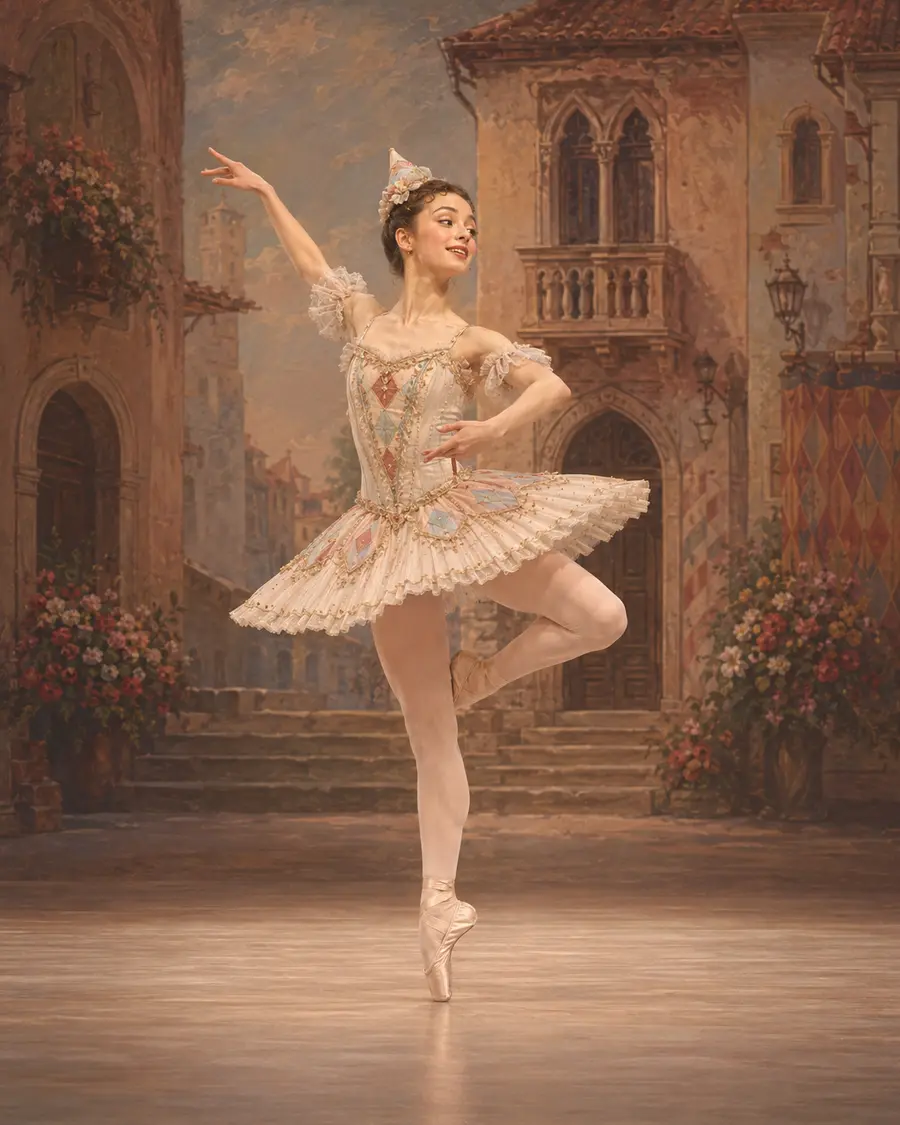
Columbine · Harlequinade
Watch from curtain to curtain
Begin with the lovers’ comic struggle in Part 1, then continue to the wedding divertissement in Part 2. Watch how gesture, focus, and musical timing make the story readable before the principal variations begin.
Act I · Part 1
Harlequinade · Act I · Part 1Playback is hosted by YouTube.
Open supplied reference ↗Act II · Part 2
Harlequinade · Act II · Part 2Playback is hosted by YouTube.
Open supplied reference ↗The complete story
The plot comes from the stock characters and situations of Italian commedia dell’arte. Clear pantomime is essential: the audience should understand desire, refusal, conspiracy, magic, and reconciliation without spoken dialogue.
Act I
Harlequin and Columbine are in love, but Columbine’s father, Cassandre, refuses to accept a penniless son-in-law. He intends to marry her to the wealthy older Léandre and relies on his servant Pierrot to keep the young lovers apart. Pierrette, Pierrot’s wife, quietly takes Columbine’s side and helps turn every solemn plan into comedy.
When ordinary cleverness is not enough, the Good Fairy comes to Harlequin’s aid. Her magic slapstick fulfills his wishes and gives the lovers the power to outwit Cassandre, Léandre, and their bumbling guardians. The chase ends with love stronger than money and the wedding finally allowed to proceed.
Act II
The second act celebrates the marriage of Harlequin and Columbine. The conflict gives way to a brilliant sequence of entrances, character dances, ensemble patterns, and classical variations. Pierrot, Pierrette, friends, attendants, and young performers fill the stage with the visual rhythms of commedia dell’arte.
At the center of the festivities, Harlequin and Columbine transform the story’s playful pursuit into a display of musical wit and classical virtuosity. The ballet closes not with another complication, but with an entire theatrical community gathered around the lovers’ triumph.
Meet the characters
These familiar commedia figures are larger than life, but they cannot become vague cartoons. Each dancer needs a distinct rhythm, posture, focus, and relationship to the other characters.
The quick-witted lover
Penniless, daring, and irrepressibly theatrical. His speed, jumps, comic timing, and magic slapstick let him turn every obstacle into another route back to Columbine.
Cassandre’s daughter
Bright, decisive, and fully committed to Harlequin. Her refined classical dancing is animated by alert focus, playful intelligence, and resistance to the marriage chosen for her.
The disapproving father
He measures a husband by wealth and social advantage. His attempts to control the household make him the principal target of the ballet’s affectionate comedy.
The wealthy rival
Cassandre’s preferred suitor: rich, older, and entirely wrong for Columbine. His confidence repeatedly collapses under the lovers’ schemes and the Good Fairy’s magic.
Cassandre’s servant
A familiar white-faced commedia figure who tries to carry out Cassandre’s orders. His solemn manner and imperfect plans create a comic contrast with Harlequin’s quickness.
The lovers’ ally
Pierrot’s wife and Columbine’s sympathetic protector. She understands the lovers, frustrates the men’s plans, and brings warmth as well as wit to the household comedy.
The agent of transformation
She recognizes true love and gives Harlequin the magical slapstick that changes his fortunes. Her intervention moves the ballet from pursuit toward celebration.
Competition variations
Ballet Variation Studio includes the familiar Columbine and Harlequin competition solos. Their present-day pas de deux tradition has a later performance history and may not reproduce the supplied full ballet exactly, so follow the version selected by the dancer’s coach.
Find the Harlequinade variationsHarlequinade · Female Variation
A buoyant comic-classical solo with fleet pointe work, neat turns, quick changes of focus, and a sparkling sense of play. Columbine’s charm must remain anchored by exact fifth positions and clean musical phrasing.
Advanced · popular · Playful · polished · vivacious
Quick footwork · pirouettes · petit allegro · character acting
Harlequinade · Male Variation
A brilliant male variation built from fast batterie, turning jumps, elevation, and comic-classical attack. The virtuosity should reveal Harlequin’s ingenuity rather than feel like an unrelated display of tricks.
Advanced · common · Daring · buoyant · quick-witted
Batterie · grand jumps · pirouettes · character acting
For variation students
Harlequinade is funniest when its classical base is exceptionally clear. The feet, landings, turns, and épaulement must remain precise enough for tiny changes of intention to register immediately.
Return to the full performanceIdentify who is speaking, who is listening, and what changes after every gesture. Avoid decorating the hands without a dramatic intention.
Small, quick steps should sound like wit in motion. Practice below tempo until fifth positions and pointe articulation stay clear.
Even in a solo excerpt, use the eyes and épaulement to suggest Columbine, Harlequin, a rival, or the audience inside the scene.
Brightness comes from crisp attack and finished musical accents—not from arriving early or shortening the transitions.
Behind the ballet
Harlequinade, originally titled Les Millions d’Arlequin, premiered at the Imperial Theatre of the Hermitage in Saint Petersburg on February 23, 1900. Marius Petipa created the choreography and libretto, Riccardo Drigo composed the score, Orest Allegri designed the décor, and Ivan Vsevolozhsky designed the costumes.
The original choreography was recorded in Stepanov notation and survives in the Sergeyev Collection. Later versions reshaped the ballet, including productions by Pyotr Gusev, George Balanchine, and Alexei Ratmansky. The widely performed modern Harlequinade pas de deux is itself a later Soviet-era construction assembled from several pieces of Drigo’s music, which explains differences between full productions and competition excerpts.