BBallet Variation Studio
← Full ballet library

Full ballet 13 · Classical story ballet in three acts

La Bayadère

A temple dancer, a warrior’s broken promise, and a jealous princess lead us from a royal celebration to the moonlit Kingdom of the Shades.

Music
Ludwig Minkus
Choreography
Natalia Makarova after Marius Petipa
Production
The Royal Ballet
World premiere
Saint Petersburg · 1877
Watch the full ballet
Nikiya in her Death Variation from La Bayadère

Nikiya · Death Variation · La Bayadère

Watch from curtain to curtain

One performance, from a secret promise to a final reunion.

Follow the story as it moves from the temple and palace to the Kingdom of the Shades. Notice how the quiet white act changes the mood of the ballet while Solor still carries the guilt of his broken promise.

La Bayadère · The Royal BalletPlayback is hosted by YouTube.

Open supplied reference ↗

Variation marker · Act I

Nikiya · Entrance Variation

Nikiya’s entrance solo in the supplied Royal Ballet production. The marker runs from the opening of the variation through its final phrase. These times are specific to the supplied production.

Start
10:16
End
12:24
Duration
2:08
Watch from 10:16 ↗

Variation marker · Act II · Engagement Celebration

Solor Variation

Solor’s solo in the supplied Royal Ballet production. The marker runs from the opening of the variation through its final phrase. These times are specific to the supplied production.

Start
50:00
End
50:58
Duration
0:58
Watch from 50:00 ↗

Variation marker · Act II · Engagement Celebration

Gamzatti Variation

Gamzatti’s solo in the supplied Royal Ballet production. The marker runs from the opening of the variation through its final phrase. These times are specific to the supplied production.

Start
51:18
End
52:36
Duration
1:18
Watch from 51:18 ↗

Variation marker · Act II · Engagement Celebration

Nikiya · Death Variation

Nikiya’s final solo at the engagement celebration in the supplied Royal Ballet production. The marker runs from the opening of the variation through its final phrase. These times are specific to the supplied production.

Start
55:18
End
58:02
Duration
2:44
Watch from 55:18 ↗

Variation marker · Act III · Kingdom of the Shades

First Shade

First Shade variation in the supplied Royal Ballet production. The marker runs from the opening of the variation through its final phrase. These times are specific to the supplied production.

Start
1:26:15
End
1:27:16
Duration
1:01
Watch from 1:26:15 ↗

Variation marker · Act III · Kingdom of the Shades

Third Shade

Third Shade variation in the supplied Royal Ballet production. The marker runs from the opening of the variation through its final phrase. These times are specific to the supplied production.

Start
1:27:28
End
1:29:04
Duration
1:36
Watch from 1:27:28 ↗

Variation marker · Act III · Kingdom of the Shades

Second Shade

Second Shade variation in the supplied Royal Ballet production. The marker runs from the opening of the variation through its final phrase. These times are specific to the supplied production.

Start
1:29:13
End
1:30:35
Duration
1:22
Watch from 1:29:13 ↗

Variation marker · Act III · Temple Wedding

Bronze Idol

Bronze Idol variation in the supplied Royal Ballet production. The marker runs from the opening of the variation through its final phrase. These times are specific to the supplied production.

Start
1:41:31
End
1:43:03
Duration
1:32
Watch from 1:41:31 ↗

Variation marker · Act III · Temple Wedding

Gamzatti Temple Variation

Gamzatti's Temple Variation in the supplied Royal Ballet production. The marker runs from the opening of the variation through its final phrase. These times are specific to the supplied production.

Start
1:46:03
End
1:48:46
Duration
2:43
Watch from 1:46:03 ↗

Performance 2

La Bayadère · Zakharova, Alexandrova, and Lantratov

Watch another interpretation with Svetlana Zakharova as Nikiya, Maria Alexandrova as Gamzatti, and Vladislav Lantratov as Solor.

La Bayadère · Second performancePlayback is hosted by YouTube.

Open supplied reference ↗

Variation marker · Performance 2

Nikiya · Entrance Variation

These times are specific to the second performance with Zakharova, Alexandrova, and Lantratov.

Start
13:52
End
15:44
Duration
1:52
Watch from 13:52 ↗

Variation marker · Performance 2

Gamzatti Entrance

These times are specific to the second performance with Zakharova, Alexandrova, and Lantratov.

Start
28:13
End
29:58
Duration
1:45
Watch from 28:13 ↗

Variation marker · Performance 2

Bronze Idol

These times are specific to the second performance with Zakharova, Alexandrova, and Lantratov.

Start
57:22
End
59:07
Duration
1:45
Watch from 57:22 ↗

Variation marker · Performance 2

Solor Variation

These times are specific to the second performance with Zakharova, Alexandrova, and Lantratov.

Start
1:13:30
End
1:14:25
Duration
0:55
Watch from 1:13:30 ↗

Variation marker · Performance 2

Gamzatti

These times are specific to the second performance with Zakharova, Alexandrova, and Lantratov.

Start
1:14:48
End
1:16:10
Duration
1:22
Watch from 1:14:48 ↗

Variation marker · Performance 2

Nikiya · Death Variation

These times are specific to the second performance with Zakharova, Alexandrova, and Lantratov.

Start
1:19:03
End
1:21:56
Duration
2:53
Watch from 1:19:03 ↗

Variation marker · Performance 2

First Shade

These times are specific to the second performance with Zakharova, Alexandrova, and Lantratov.

Start
1:50:33
End
1:51:29
Duration
0:56
Watch from 1:50:33 ↗

Variation marker · Performance 2

Second Shade

These times are specific to the second performance with Zakharova, Alexandrova, and Lantratov.

Start
1:51:37
End
1:52:52
Duration
1:15
Watch from 1:51:37 ↗

Variation marker · Performance 2

Third Shade

These times are specific to the second performance with Zakharova, Alexandrova, and Lantratov.

Start
1:53:10
End
1:54:26
Duration
1:16
Watch from 1:53:10 ↗

The complete story

A promise broken on earth survives beyond it.

The Royal Ballet performs Natalia Makarova’s three-act version after Marius Petipa. The story places Nikiya and Solor’s private love against royal duty, courtly power, jealousy, and betrayal.

01

Act I

A secret promise leads to danger

Outside the temple, the warrior Solor asks his friend Magdaveya to arrange a secret meeting with Nikiya, the sacred temple dancer he loves. During the temple ceremony, the High Brahmin declares his own love for Nikiya, but she rejects him. Later, Nikiya meets Solor in secret. In front of the sacred fire, they promise to love each other forever. The jealous High Brahmin watches them and decides to expose their relationship.

At the palace, the Rajah announces that Solor will marry his daughter, Gamzatti. Solor is stunned, but he does not openly refuse the Rajah. The High Brahmin then reveals Solor and Nikiya’s secret love, expecting the Rajah to punish Solor. Instead, the Rajah decides that Nikiya must die. Gamzatti learns the truth too and privately confronts Nikiya. She offers Nikiya jewels and riches if she will give up Solor. Nikiya refuses. Their argument becomes violent, and Nikiya nearly attacks Gamzatti before fleeing in horror. Gamzatti is left determined to remove her rival.

02

Act II

A joyful party hides a deadly plan

The palace gardens are filled with guests celebrating the engagement of Solor and Gamzatti. The scene is brilliant and festive, with ceremonial dances, the Bronze Idol, and displays for the royal couple, but the audience knows that Nikiya is in danger. Nikiya is ordered to dance at the celebration of the man she loves and the princess he is expected to marry. Her dancing is full of grief, and Solor can do little to comfort her in front of the court.

A basket of flowers is brought to Nikiya. Believing it is a secret gift from Solor, she becomes joyful and dances with it. A poisonous snake hidden inside the basket bites her. The High Brahmin rushes forward with an antidote and offers to save her, but only if she will abandon Solor and accept his love. For a moment Nikiya reaches toward the medicine. Then she sees Solor with Gamzatti and remembers the promise she made to him. She rejects the antidote and dies rather than betray that promise.

03

Act III

Solor dreams of Nikiya again

Solor is overwhelmed by guilt and grief after Nikiya’s death. Seeking escape, he enters a dreamlike vision called the Kingdom of the Shades. One by one, the white-veiled Shades descend in a long repeated procession, creating one of ballet’s most famous corps de ballet scenes. In this otherworldly place, Solor sees Nikiya again. The Shades dance around them, and Nikiya forgives him. Their reunion is beautiful, but it exists only in Solor’s vision.

When the vision ends, Solor must return to the world he tried to escape. His wedding to Gamzatti begins at the temple, even though he is still bound emotionally to Nikiya. During the ceremony, a basket of flowers appears and reminds everyone of Nikiya. The gods, angered by the broken sacred promise, destroy the temple. In Natalia Makarova’s ending, Solor dies in the destruction and the final image reunites the spirits of Nikiya and Solor, suggesting that the promise they could not keep in life is finally fulfilled beyond it.
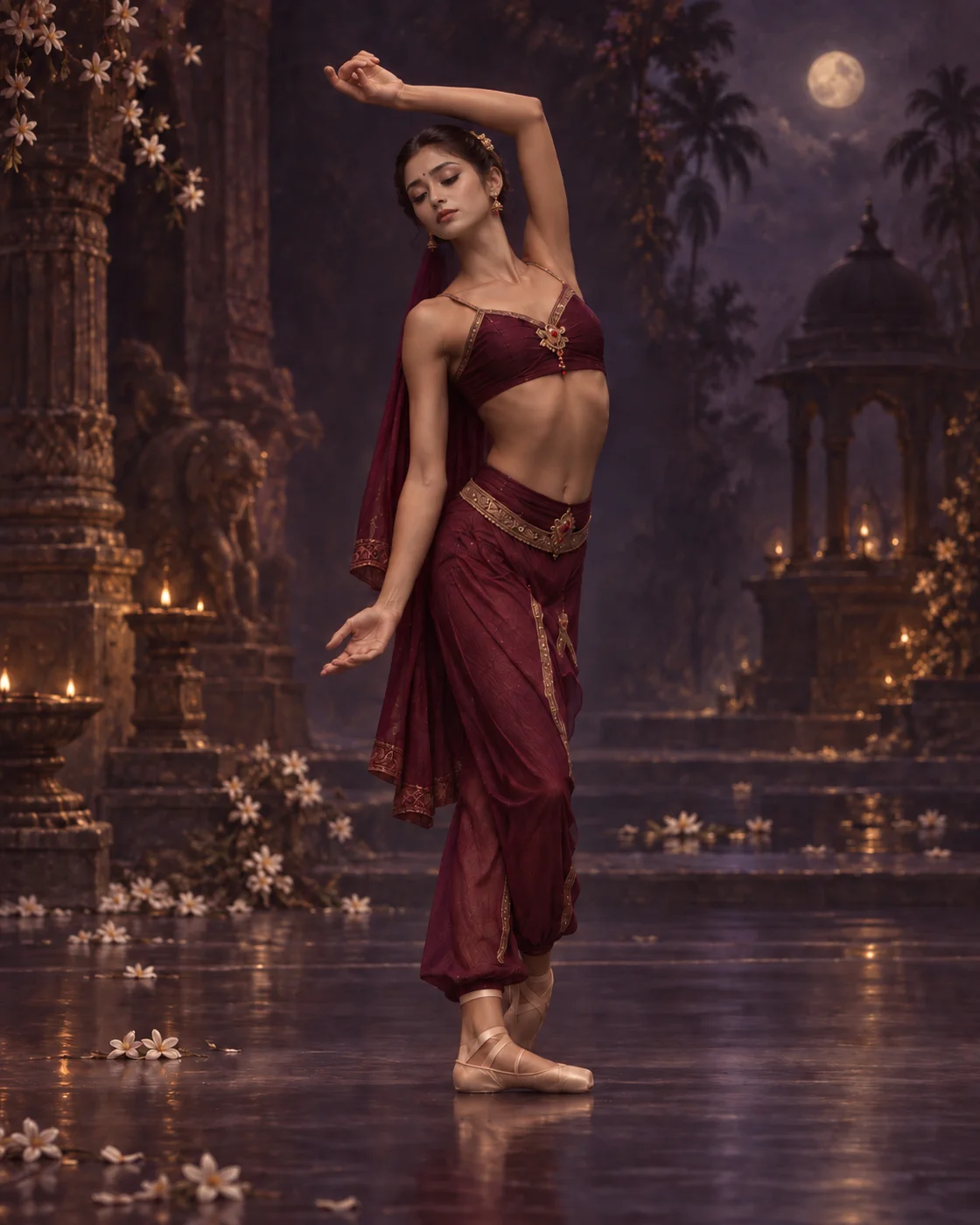
Meet the characters

Every relationship is shaped by a promise.

Love, duty, jealousy, and power pull the characters in different directions. Clear acting and eye focus help the audience understand the story without words.

01

The sacred temple dancer

Nikiya

She is a devoted temple dancer who secretly loves Solor. She stays true to their promise even when powerful people try to separate them.

02

The warrior

Solor

He loves Nikiya but agrees to marry Gamzatti when the Rajah orders it. His broken promise causes the tragedy and later fills him with guilt.

03

The Rajah’s daughter

Gamzatti

She is proud and used to getting what she wants. When she learns that Solor loves Nikiya, jealousy makes her dangerous.

04

The jealous temple authority

The High Brahmin

He loves Nikiya and tells the Rajah about her secret meeting with Solor. Later, he will save her only if she agrees to give up Solor.

05

Gamzatti’s father

The Rajah

He orders Solor to marry Gamzatti. When he learns about Nikiya, he sees her as a problem and decides that she must die.

06

Solor’s trusted friend

Magdaveya

He is Solor’s trusted friend. He helps Solor arrange the secret meeting with Nikiya near the temple.

Competition variations

Ten solos with several distinct moods.

Nikiya’s variations move from serene ceremony to tragedy, while Solor is noble and expansive. All three Gamzatti solos are proud and royal. The three Shade variations are calm and dreamlike, while the Bronze Idol is sharp and powerful. Each solo should keep its character even outside the full ballet.

Find the La Bayadère variations
  1. 01

    Nikiya Entrance Variation

    La Bayadère · Nikiya

    Nikiya enters as the sacred temple dancer at the center of the ballet’s love story. The solo should feel calm and ceremonial, with sustained balances, extensions, and lyrical classical line rather than overt display.

    Advanced · common · Serene · devotional · ceremonial

    Balances · extensions · sustained adagio · arabesque control

  2. 02

    Nikiya Death Variation

    La Bayadère · Nikiya · Act II

    Nikiya dances through grief, hope, and shock before the poisoned flower basket turns the celebration into tragedy. The solo requires pointe stamina, musical control, and mature storytelling.

    YAGP: Nikiya Death Variation is not accepted for competition unless the variation is under 2:40.

    Advanced · common · Lyrical · tragic · dramatic

    Balances · piqué turns · quick footwork · extensions · character acting

  3. 03

    Solor Variation

    La Bayadère · Male Variation

    Solor’s solo combines grand jumps, turns, beaten steps, and precise landings. The warrior prince should look powerful and musical without sacrificing classical line or control.

    Advanced · common · Noble · heroic · expansive

    Grand jumps · pirouettes · batterie · quick footwork · character acting

  4. 04

    Gamzatti Variation

    La Bayadère · Princess Gamzatti

    A proud palace solo with strong balances, turns, large jumps, and clear classical lines. Gamzatti should look calm, confident, and royal.

    Advanced · common · Regal · proud · commanding

    Balances · pirouettes · grand jumps · character acting

  5. 05

    Gamzatti Temple Variation

    La Bayadère · Natalia Makarova choreography

    A sustained, technically exposed temple solo with controlled balances, extensions, and calm classical line.

    YAGP: Gamzatti Temple Variation (choreography by N. Makarova) is NOT accepted without permission from N. Makarova.

    Advanced · rare · permission required · Regal · measured · ceremonial

    Balances · extensions · sustained adagio · character acting

  6. 06

    Gamzatti Entrance Variation

    La Bayadère · Gamzatti entrance · Competition edition

    Gamzatti’s entrance variation combines poised balances, controlled turns and extensions, articulate pointe work, and calm royal authority.

    Advanced · common · Regal · poised · musically precise

    Balances · pirouettes · extensions · quick footwork · character acting

  7. 07

    First Shade

    La Bayadère · Kingdom of the Shades

    A slow adagio variation with high extensions, long balances, and controlled arabesques. The dancer must stay calm and smooth between each position.

    Advanced · common · Calm · balanced · smooth

    Extensions · balances · sustained adagio · arabesque

  8. 08

    Second Shade

    La Bayadère · Kingdom of the Shades

    Repeated hops en pointe and quick steps should look light and easy. Strong alignment helps the dancer keep a quiet, graceful upper body.

    Advanced · common · Buoyant · precise · weightless

    Hops en pointe · arabesque · quick footwork · balances

  9. 09

    Third Shade

    La Bayadère · Kingdom of the Shades

    A calm classical solo that needs secure pointe work, clear arabesque lines, and careful timing. Each position should feel finished but never stiff.

    Intermediate · common · Calm · quiet · unhurried

    Pointe alignment · arabesque · balances · épaulement

  10. 10

    Bronze Idol

    La Bayadère · Male Variation

    The golden statue comes to life with strong poses, beaten jumps, turns, and quick steps. After each powerful movement, the dancer returns to stillness.

    Advanced · common · Statue-like · powerful · bold

    Grand jumps · batterie · quick footwork · character acting

For variation students

Stillness must remain alive.

La Bayadère needs strong placement that does not look tense. Good preparation, breathing, and focus help difficult pointe work and jumps look calm and natural.

Return to the full performance
  1. 01

    Keep the adagio steady

    Set the supporting foot and hips before lifting the leg. Keep the body stable instead of pushing the leg higher than you can control.

  2. 02

    Build pointe strength slowly

    For the Second Shade, practice the hops in small groups. Join them together only when the ankle, toes, and body stay in line.

  3. 03

    Watch the corps de ballet

    The Kingdom of the Shades entrance shows the correct arms, upper-body positions, spacing, and tempo. A solo Shade should feel part of the same world.

  4. 04

    Finish every Bronze Idol pose

    Complete every jump and turn in a clear shape. The character comes from changing quickly between powerful movement and complete stillness.

Behind the ballet

An Imperial ballet brought to today’s stage.

La Bayadère first appeared at the Imperial Bolshoi Kamenny Theatre in Saint Petersburg in 1877. Marius Petipa created the choreography and wrote the story with Sergei Khudekov. Ludwig Minkus wrote the music. The original ballet had four acts and seven scenes. Later versions changed the order and length, but kept the famous Kingdom of the Shades.

Natalia Makarova created this full-length version for The Royal Ballet in 1989, after first staging the ballet for American Ballet Theatre. John Lanchbery arranged the music. Makarova’s version brings back the destruction of the temple and the final reunion of Nikiya and Solor. The setting shows a nineteenth-century European idea of India. It does not show real Indian dance or culture, and that is important to remember when studying the ballet today.

Royal Ballet performance reference ↗Petipa Society history and original scenario ↗Royal Ballet and Opera Collections ↗
Feedback / Report a bug