BBallet Variation Studio
← Full ballet library

Full ballet 14 · Pastoral comedy

La Fille mal gardée

Young love, a determined mother, and a marriage plan that goes delightfully wrong.

Also known as
The Wayward Daughter
Music in this reference
Ferdinand Hérold · arranged by John Lanchbery
Reference
Serbian National Theatre · conductor Aleksandar Kojić
Original ballet
Jean Dauberval · Bordeaux, 1789
Watch the full ballet
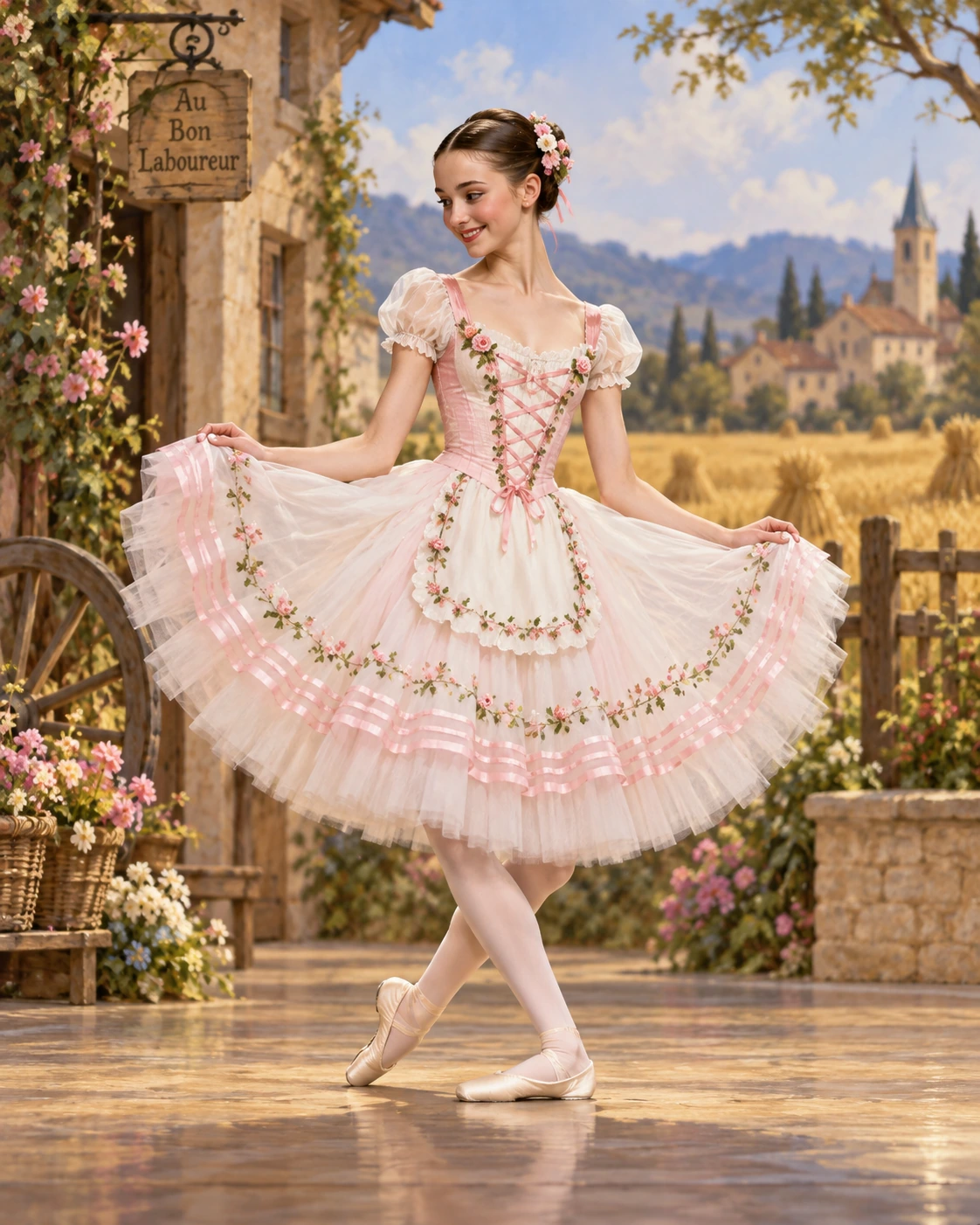
Lise dancing in a sunlit village in La Fille mal gardée

Lise · La Fille mal gardée

Watch from curtain to curtain

La Fille mal gardée · Serbian National Theatre

The supplied upload credits the Hérold–Lanchbery score and conductor Aleksandar Kojić. Watch how the dancers combine village comedy, mime, and classical dancing.

Hérold–Lanchbery · La Fille mal gardéePlayback is hosted by YouTube.

Watch from the beginning ↗

The story

Lise chooses love.

This outline follows the familiar two-act Ashton telling; scene divisions and choreography vary between productions.

01

Act I

A ribbon, a rival, and a harvest celebration

The farmyard wakes to a cock and hens. Lise is looking for Colas, the young farmer she loves, and leaves him a ribbon as a message. When they meet, their happiness is interrupted by her mother, Widow Simone. Simone puts Lise to work churning butter, hoping to keep her occupied, but Colas finds another chance to join her. Even an ordinary chore becomes an opportunity for flirtation.

Simone has a more profitable marriage in mind. Thomas, a wealthy vineyard owner, arrives with his son Alain to arrange the match. Alain tries awkwardly to impress Lise, but she has no interest in him. Later, the harvesters celebrate in the fields, and Colas makes sure he is the one dancing with Lise. The festivities include ribbon patterns around a maypole and Simone’s comic clog dance. A thunderstorm suddenly ends the party. Everyone seeks cover, while Alain’s beloved umbrella catches the wind and carries him away.

02

Act II

The hiding place that brings the lovers together

Back inside the farmhouse, Simone tries another strategy: keeping Lise at the spinning wheel under her supervision. Lise is still thinking about Colas. As Lise dances, Simone accompanies her on the tambourine. Simone gradually becomes drowsy and eventually falls asleep, giving Lise a brief break from her watchful eye. Farm workers bring in the harvest, and Colas finds a hiding place among it. When Lise believes she is alone, she acts out her dreams of marriage and children. Colas reveals himself, embarrassing and delighting her: he has witnessed the future she imagines for them.

Their reunion is interrupted by Simone’s return. Lise hurriedly hides Colas in her bedroom. Simone then sends Lise into the same room and locks the door, unaware that her precautions have brought the couple together. Thomas and Alain arrive with a notary to settle the marriage contract. Given the key, Alain opens the bedroom and discovers Lise with Colas. Thomas is furious, and the arranged match collapses. The young lovers appeal to Simone, who finally gives them her blessing. The celebration ends happily, with Alain returning for the companion he still cherishes: his umbrella.

Meet the characters

Five people, two very different marriage plans.

01

The spirited daughter

Lise

Lise loves Colas and wants to choose her own future. Playful and resourceful, she turns chores into opportunities to meet him. Her teasing confidence gives way to tenderness when she imagines their married life.

02

The young farmer

Colas

Colas is Lise’s devoted sweetheart and Alain’s rival. He finds ways around Simone’s supervision, joining Lise in the farmyard and later hiding inside the farmhouse. His warmth and confidence make their affection feel mutual.

03

Lise’s protective, practical mother

Widow Simone

Simone believes a wealthy husband will secure her daughter’s future. She uses work, supervision, and locked doors to enforce her plans, but repeatedly misjudges the lovers. Her final change of heart makes the happy ending possible.

04

The awkward prospective groom

Alain

Alain is Thomas’s son and the husband Simone has chosen for Lise. His clumsy attempts at courtship create comedy, while his attachment to his umbrella gives him a world of his own. He is a mismatched suitor rather than a villain.

05

The wealthy father arranging the match

Thomas

Thomas approaches the marriage as an agreement between families and expects his son to be accepted. Protective of Alain and conscious of his standing, he takes offence when the discovery of Colas ruins the arrangement.

Variation connections

Meet Lise and Colas through their variations.

The catalogue includes Lise solos from Act I and Act II and Colas’s Act I and Act II variations. Compare each reference and its music separately, since musical and choreographic editions differ.

Find the variations →
  1. 01

    Lise · Gorsky Pas de Deux Variation

    Study the playful gestures alongside the footwork. Let each glance and change of direction express a clear intention, while keeping the steps light and precise.

  2. 02

    Lise · Harvest Pas de Deux Variation — Nijinska/Romanoff Version

    A rarer Lise variation from the Act I harvest scene pas de deux. Keep the traveling phrases buoyant and clear, with warm musicality, playful character, and natural épaulement.

  3. 03

    Lise · Harvest Pas de Deux Variation — Ashton Version

    La Fille mal gardée · Act I · Harvest Scene. A sunny, buoyant solo with lively footwork and expressive musical phrasing. A supplied rehearsal recording is available in the Music Library.

    Watch Alianna Nassos · YAGP Finals ↗
  4. 04

    Lise · Act I Variation — Hertel/Gorsky tradition

    A playful Act I solo with bright phrasing and expressive coordination. Four rehearsal tracks are available in the Music Library.

    Watch Victoria Carrillo · YAGP Finals 2023 ↗
  5. 05

    Colas · Act II Variation — Hertel/Gorsky tradition

    Lise’s sweetheart faces Simone’s plan to marry her to Alain. Compare four supplied recordings, with the shortest on the variation card.

    Watch Joseph Kirillov · YAGP Dallas 2026 ↗
  6. 06

    Colas · Act I Variation

    Colas is Lise’s young sweetheart, determined to be with her despite Simone’s plans for a wealthier match. Compare three supplied recordings in the variation guide.

    Watch the supplied Colas Act I reference ↗

Behind the ballet

A comedy with more than two centuries of reinvention.

1789 · Bordeaux. Jean Dauberval created La Fille mal gardée at the Grand Théâtre de Bordeaux, making it one of the oldest ballets still regularly performed. Its appeal was unusual for the period: instead of gods, princes, or supernatural tragedy, the story centered on recognizable village characters, a stubborn mother, and a young woman determined to marry for love.

1828 · Paris and the Hérold score. Jean-Pierre Aumer restaged the ballet for the Paris Opera with a new score assembled and arranged by Ferdinand Hérold. This musical lineage became the basis for later French and British versions, although individual numbers and orchestrations continued to change as the ballet traveled.

1864 · The Hertel tradition. Paul Taglioni mounted a new production in Berlin with an entirely new score by Peter Ludwig Hertel. That version became especially important in Russia. Marius Petipa and Lev Ivanov reshaped the ballet for the Imperial stage, and Alexander Gorsky later revised it for the Bolshoi in 1903. The Hertel/Gorsky line developed its own choreography, interpolated music, and famous pas de deux material, much of which now survives independently in galas and ballet competitions.

1960 · Ashton’s Royal Ballet version. Frederick Ashton created the production that is now the best-known full-length version in the West. John Lanchbery reworked and orchestrated Hérold’s music, while Ashton built the ballet around English pastoral comedy, intricate mime, ribbon dances, the celebrated clog dance, and the affectionate relationship between Lise and Colas. The Serbian National Theatre reference above follows this Hérold–Lanchbery/Ashton tradition.

Why the variations do not always match. Today, several production lineages coexist. A variation labeled “Lise” or “Colas” may come from Ashton’s 1960 staging, from the Hertel/Gorsky Russian tradition, or from a later competition edition that preserves only part of an older pas de deux. Music may also have been interpolated from other composers. That is why the same character can appear with different choreography, different music, and even a different place in the story depending on the production.
Supplied performance and credits ↗Royal Ballet and Opera · Ashton history ↗The Petipa Society · Russian production history ↗
Feedback / Report a bug