Related variation · separate performance reference
The Sylph · Variation 2
Study Catherine Parker’s YAGP Paris 2019 performance and compare the two supplied music recordings.
Romantic story ballet · two acts
On his wedding morning, James follows an elusive Sylph from a Scottish farmhouse into the forest—and discovers that a dream can be destroyed by the attempt to possess it.
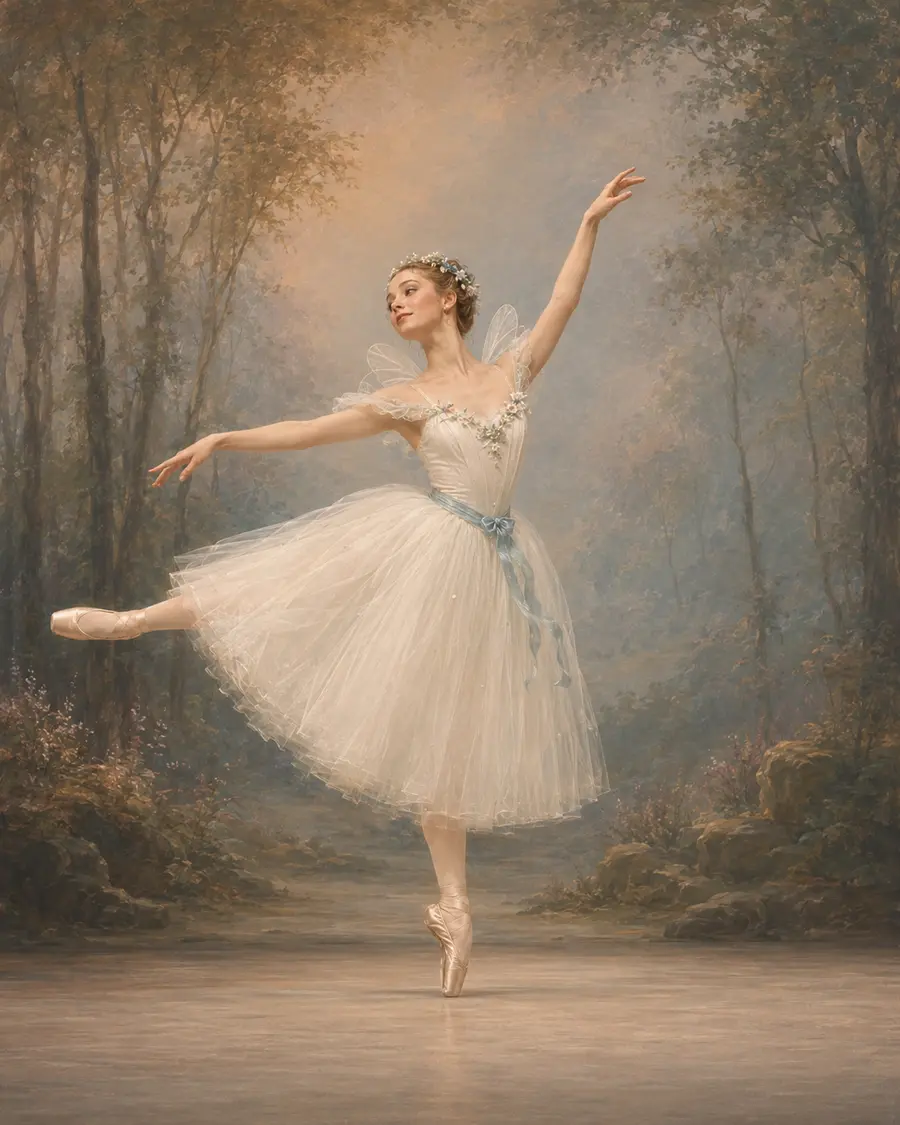
The Sylph · Variation 1
Watch the supplied production
Follow James as an ordinary wedding morning gradually gives way to the supernatural. The ballet moves from the lively Scottish household into the mysterious forest, where his fascination with the Sylph becomes stronger, more dangerous, and ultimately tragic.
La Sylphide · supplied performance referenceReference begins at 1:03:34 · playback is hosted by YouTube.
Open the supplied reference ↗Related variation · separate performance reference
Study Catherine Parker’s YAGP Paris 2019 performance and compare the two supplied music recordings.
Variation marker · Act II
The Sylph · Variation 1 variation in the supplied La Sylphide production. These times are specific to the supplied production.
The complete story
Act I is grounded in family, marriage, and Scottish social life. Act II moves into a supernatural forest where James tries to hold onto the very thing whose beauty depends on remaining free.
Act I
On the morning of his wedding to Effie, the young Scotsman James wakes to find a mysterious winged Sylph beside the hearth. She vanishes whenever anyone else approaches, leaving James unsure whether he has seen a spirit or imagined her. As Effie, her friends, and the household prepare for the wedding, James becomes increasingly distracted by the Sylph's returns.
The fortune-teller Madge arrives and predicts that Effie will marry Gurn rather than James. James angrily drives Madge away, making an enemy of her. During the wedding festivities the Sylph continues to draw James away from the human world. When she steals the wedding ring meant for Effie and escapes toward the forest, James finally abandons the ceremony and follows her, leaving Effie heartbroken.
Act II
In the forest, James enters the Sylph's supernatural world. She and the other sylphs surround him with dances that seem close enough to touch yet remain impossible to possess. James is enchanted but frustrated: every attempt to hold the Sylph makes her slip away. Meanwhile, Madge prepares her revenge and gives James an enchanted scarf, telling him it will allow him to keep the Sylph beside him.
James wraps the scarf around the trusting Sylph. Instead of binding her safely to him, the spell destroys her wings and she dies. Her sisters carry her away as James realizes that his desire to possess the dream has destroyed it. In the distance he sees that Effie has accepted Gurn and their wedding procession passes by. Overwhelmed by the loss of both worlds he tried to choose between, James collapses while Madge celebrates the fulfillment of her curse.
Meet the characters
James is pulled between ordinary happiness and impossible desire. Effie and Gurn keep the human stakes visible, while the Sylph and Madge turn that conflict into the supernatural language of Romantic ballet.
The young Scottishman
James begins the ballet on the morning of his wedding to Effie, but the Sylph awakens a longing for something beyond ordinary life. His tragedy comes from trying to turn an untouchable ideal into something he can possess.
A spirit of the air
Playful, tender, and elusive, the Sylph belongs to a supernatural world that James can enter but never truly possess. She represents the beauty and danger of an impossible dream—intimate enough to draw him away from his ordinary life, yet always beyond the limits of the human world.
James's human bride
Effie represents the warm, social world James is preparing to enter through marriage. She is not a villain or obstacle; her heartbreak makes James's pursuit of the Sylph a real human choice with consequences.
James's friend and Effie's admirer
Gurn loves Effie and sees James's fascination with the Sylph before others do. After James abandons the wedding, Gurn becomes the possibility of a steadier human future for Effie.
The witch and agent of revenge
Madge reads the future, exposes the instability beneath the wedding celebration, and remembers James's cruelty toward her. Her enchanted scarf turns his wish to capture the Sylph into the instrument of the tragedy.
Behind the ballet
1832 · Paris. The original La Sylphide premiered at the Paris Opéra on 12 March 1832. Filippo Taglioni choreographed it for his daughter Marie Taglioni, with music by Jean-Madeleine Schneitzhoeffer and a scenario by the tenor Adolphe Nourrit. Marie Taglioni's ethereal style helped make the white Romantic tutu, pointe work, and supernatural heroine defining images of the era.
1836 · Copenhagen. August Bournonville created a new version for the Royal Danish Ballet, using Nourrit's story but commissioning a new score from Herman Severin Løvenskiold. The Bournonville La Sylphide premiered in Copenhagen in 1836 and became one of the central works of the Danish repertory.
The 1832 Taglioni choreography did not survive as a continuously performed stage tradition, while Bournonville's version was preserved by the Royal Danish Ballet. That makes the familiar modern La Sylphide both a key Romantic ballet and a living record of Bournonville style: quick footwork, buoyant jumps, understated arms, musical precision, and expressive mime.
The ballet's tragedy is distinctly Romantic. James is not choosing between good and evil; he is choosing between the tangible world and an ideal he cannot keep. The final scarf scene turns that longing into the ballet's central warning: once James tries to possess the Sylph, the dream itself is destroyed.