BBallet Variation Studio
← Full ballet library

Full ballet 06 · Ballet-fantastique in three acts

Le Talisman

A celestial maiden carries the power to return to heaven—until a mortal act of selfless love gives her the freedom to choose where she belongs.

Music
Riccardo Drigo
Original choreography
Marius Petipa
World premiere
St. Petersburg · 1889
Supplied staging
Aleksander Mishutin · 2019
Watch the full ballet
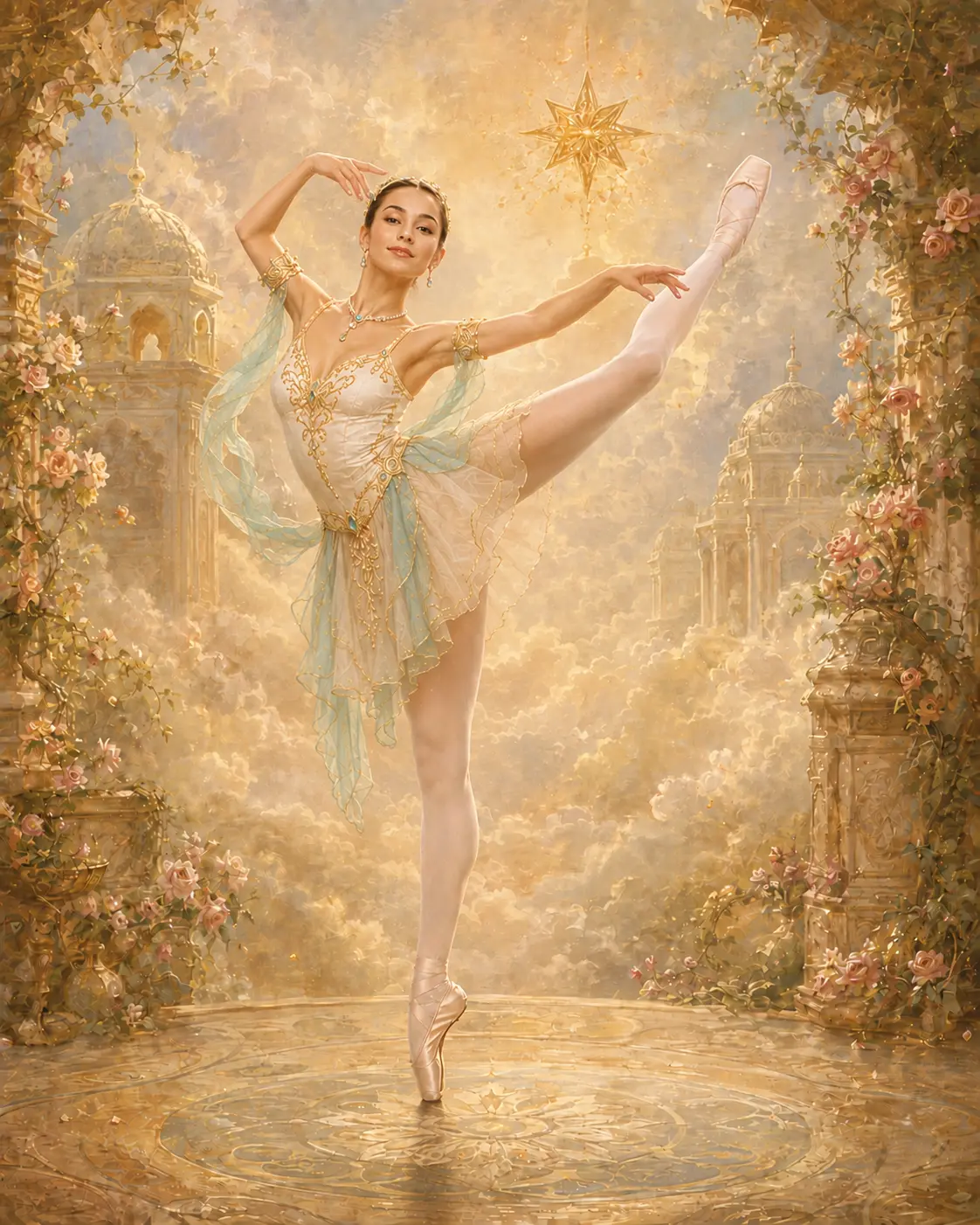
Illustration of Niriti in a short celestial tunic beneath a glowing star-shaped talisman

Niriti · The celestial maiden

Watch from curtain to curtain

Meet the competition classic inside a complete world.

This 2019 Buryat Opera and Ballet Theatre production restores the larger celestial story around music better known today through the Talisman Pas de Deux. Watch first for the plot, then return to study character, musical themes, and atmosphere.

Le Talisman · Buryat Opera and Ballet Theatre · 2019Three-act staging · playback is hosted by YouTube.

Open on YouTube ↗

The complete story

A test of love becomes a test of freedom.

The supplied modern staging uses three acts. The original 1889 production was presented in four acts and seven scenes, and later revivals simplified the structure and changed the names Ella and Uragan to Niriti and Vayou.

01

Act I

A goddess descends to earth

In the celestial realm, Queen Amravati must send her daughter Niriti to earth to test whether her heart can resist mortal love. Vayou, god of the wind, accompanies her, while a star-shaped talisman gives Niriti the power to return to heaven. If she loses it, she can return only when a mortal freely gives it back.

Near the home of the weaver Kadoor, Niriti encounters Noureddin, the young Maharajah of Lahore. He is captivated by her, but Vayou summons a storm so they can escape. In the confusion Niriti drops the talisman, and Noureddin finds it and vows to discover the mysterious maiden's identity.

02

Act II

A royal wedding is interrupted

At King Akdar's palace, celebrations prepare Noureddin to marry Princess Damayanti. Yet he cannot forget Niriti. Disguises, visions, and the grand Rose of Bengal divertissement become part of Niriti and Vayou's attempt to recover the talisman without revealing its power.

Noureddin rejects the arranged marriage and declares his love for Niriti. The palace erupts, and Vayou uses the elements to protect the lovers. Niriti begins to understand that Noureddin's devotion is not a passing temptation, even though returning to him may cost her immortality.

03

Act III

The talisman is freely returned

In a crowded bazaar, Niriti and Vayou try once more to trade for the talisman. Noureddin refuses, having realized that it is the key to Niriti's freedom. After Vayou's powers fail, Niriti is left to plead directly with the man who loves her.

Noureddin finally chooses Niriti's freedom over his own happiness and returns the talisman without condition. Heaven opens to receive her, but Niriti turns back. She lets the talisman rise alone and embraces mortal life with Noureddin, choosing earthly love over immortality.
Meet the characters

Heavenly power meets mortal choice.

The ballet's fantasy machinery works because every supernatural event sharpens a human question: possession or freedom, duty or desire, immortality or love.

01

The celestial heroine

Niriti

Also called Ella in the original version. She descends to earth protected by the talisman and gradually discovers that love can be a free choice rather than a failed test.

02

The Maharajah of Lahore

Noureddin

He begins as a privileged prince promised to another woman, but proves his love when he gives Niriti the talisman and the freedom to leave him.

03

The god of the wind

Vayou

Niriti's guardian and companion, called Uragan in the original production. His storms, disguises, and comic vulnerability drive much of the action.

04

Queen of the Heavens

Queen Amravati

Niriti's mother, who sends her daughter to earth and provides the talisman that makes a return to the celestial realm possible.

05

The intended bride

Princess Damayanti

King Akdar's daughter and Noureddin's promised wife. His rejection of their royal match turns a private love story into a public crisis.

06

The earthly ruler

King Akdar

Damayanti's father, whose palace wedding plans and anger at Noureddin's refusal raise the stakes of the lovers' choice.

For variation students

Separate the full ballet from the familiar pas de deux.

The Talisman Pas de Deux widely danced at competitions is a later 1955 arrangement by Pyotr Gusev, not an intact duet preserved from Petipa's original production. Use the full ballet for dramatic world and musical color, while following the exact pas de deux edition selected by the dancer's coach.

Open the Variation Finder
  1. 01

    Begin with celestial calm

    Niriti's authority comes from stillness and clarity. Let the upper body remain expansive even when the feet become quick.

  2. 02

    Dance the talisman as an idea

    The object represents freedom and the power to choose. Focus and gesture should make its importance legible without overacting.

  3. 03

    Keep ornamentation precise

    Detailed arms, head changes, and musical accents need clean coordination so the exotic fantasy never becomes decorative clutter.

  4. 04

    Confirm the competition edition

    The familiar duet combines later choreography and music from several sources. Match the recording and choreography before rehearsing details.

Behind the ballet

A lost Imperial spectacle, rebuilt for a modern stage.

Marius Petipa created Le Talismanto Riccardo Drigo's score for Elena Cornalba's benefit performance at the Imperial Mariinsky Theatre in 1889. The production was notable for two substantial male roles: Noureddin and the virtuoso wind god Uragan, created by Enrico Cecchetti.

Most of Petipa's choreography disappeared after the ballet left the repertory. Aleksander Mishutin's 2019 staging for the Buryat Opera and Ballet Theatre uses Drigo's music in a revision by Yuriy Kozhevatov, presenting the fantasy as a three-act work. The production was later shown at the Mariinsky's Primorsky Stage.

Supplied full production ↗Mariinsky production credits ↗Marius Petipa Society history ↗